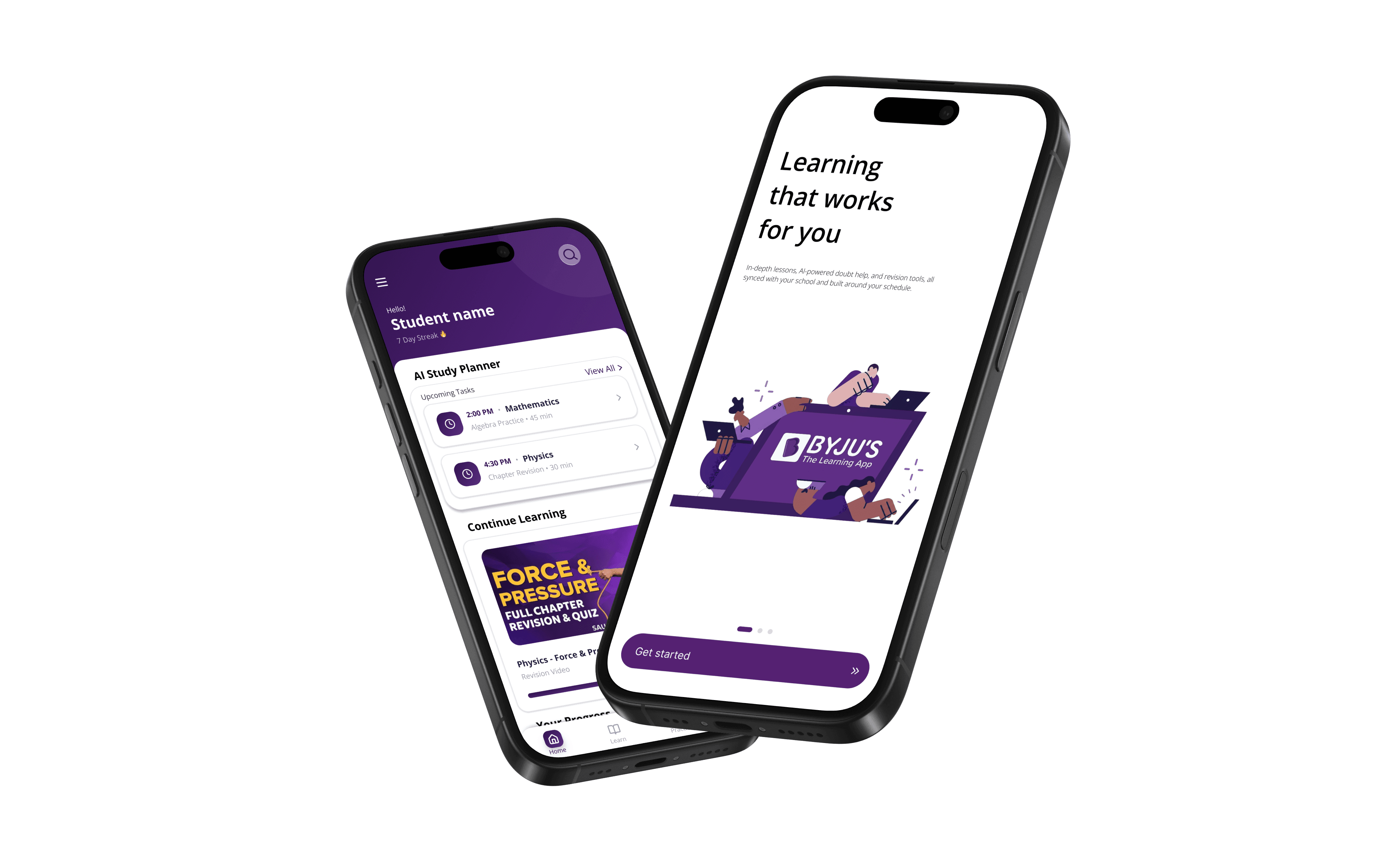


Byjus 2.0
Rebuilding an app from failure to function
Team: 3 People
Contribution: Research, Analysis, User Experience, Interaction design and Prototyping
Byju's sold parents a promise. We wanted to see what happens when it shows proof instead.

Redesigning Byju's around a new mental model, built for how parents and kids learn and trust today.
(Context)
Byju's became one of the biggest names in learning by selling a belief: buy the app and your child will improve. That belief carried the brand until parents started asking where the results were. This project looks at why the model broke, and what a learning product has to be once trust is gone.
(Research)
We started with the brand, not the interface. Using the five planes of UX to take Byju's apart from the foundation up, so we could see which layer was actually failing and which were just showing the damage.
(Users)
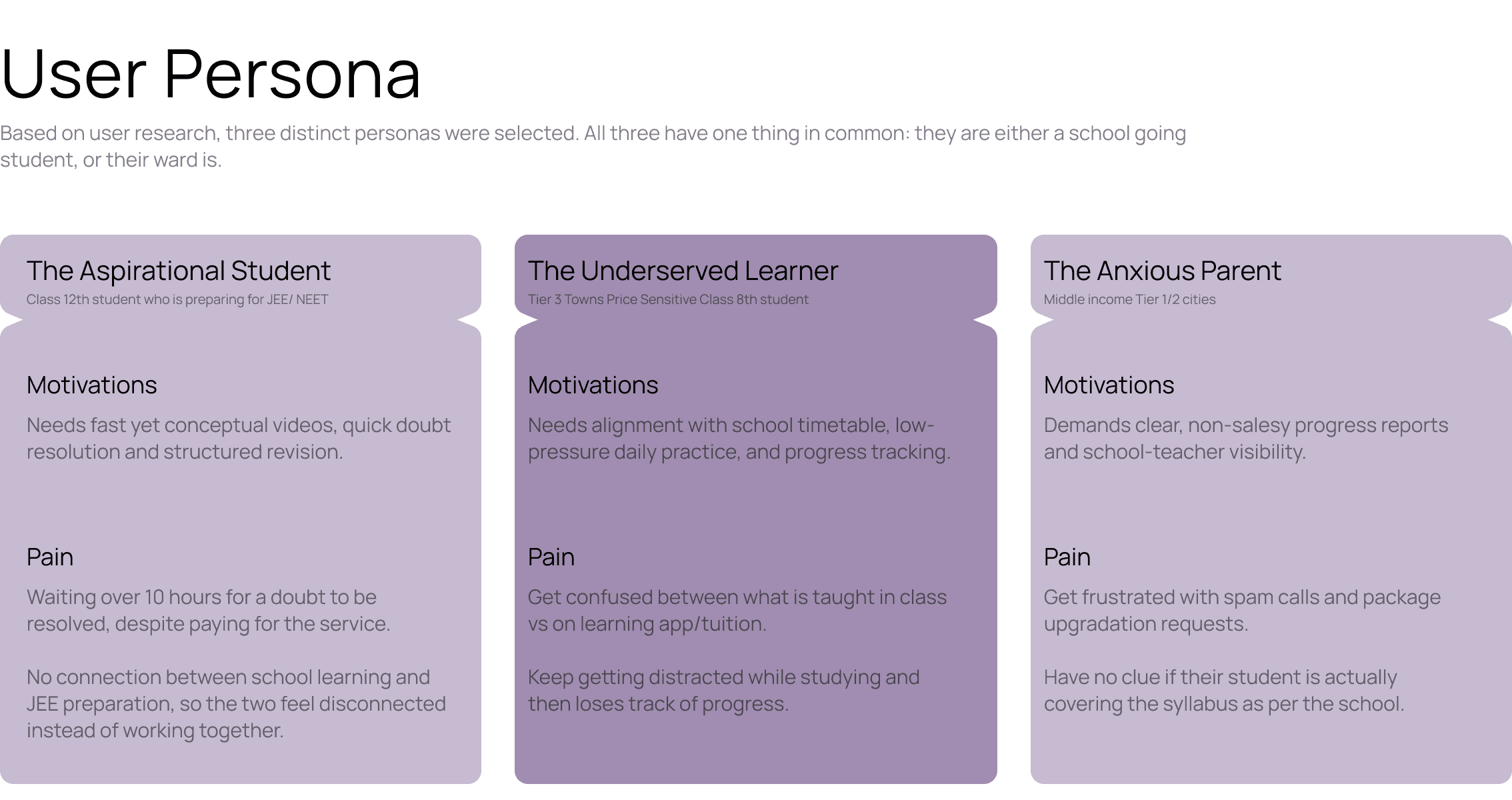
Two people use this product but only one of them pays for it. Parents want visible proof that their money is working. Kids want to learn without feeling like they are being sold to. The old model served neither well.


What we found was that the screens were never the root problem. The mental model underneath them was. Byju's set out to democratize education. Somewhere along the way it started chasing valuation instead. The product lost sight of the people it was built for, and the gap between what it promised and what it delivered grew wider with every quarter of growth.

From user insight: The product was meant for students who needed quality education. In reality, they were pressured into buying. The person who paid and the person who learned were treated as the same, and the child's needs were ignored.
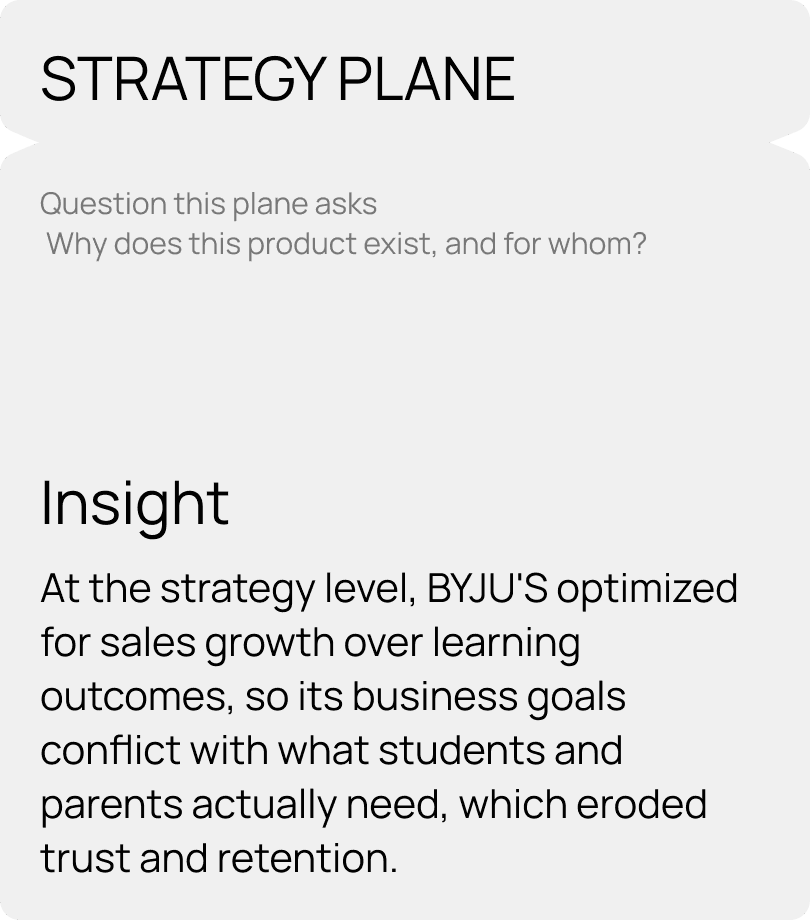


BYJU'S strong features are undermined at every plane: a sales-first strategy, missing personalization features, syllabus-based structure, disconnected flow, and a cluttered, pressuring surface, so users get a generic, pushy experience instead of guided learning.
That is where our solution started.
Byju's promised value it never delivered. This version keeps that promise.
We built a Value Proposition Canvas to align Byju's with what its users actually need.

Every gap on this canvas points to the same shift. Byju's has to stop selling a promise and start showing proof, to a parent and a child who each need something different from it. The app spoke to the parent's hope, and gave the child very little to hold onto.
Introducing Byjus 2.0
The goal was to shift BYJU'S into a learning-first brand which provides a visible proof and should adapt with todays education.
By collaborating with schools, the app now moves at the same pace and flow as the classroom, so students are not distracted or juggling 2 or 3 different topics at once. Students can explore freely, get an AI-planned day built around school hours, and track progress against their targets. When they get stuck, instant help from Byx AI or a human mentor is always there.
Whereas parents can see their ward's progress with respect to school on their own device.
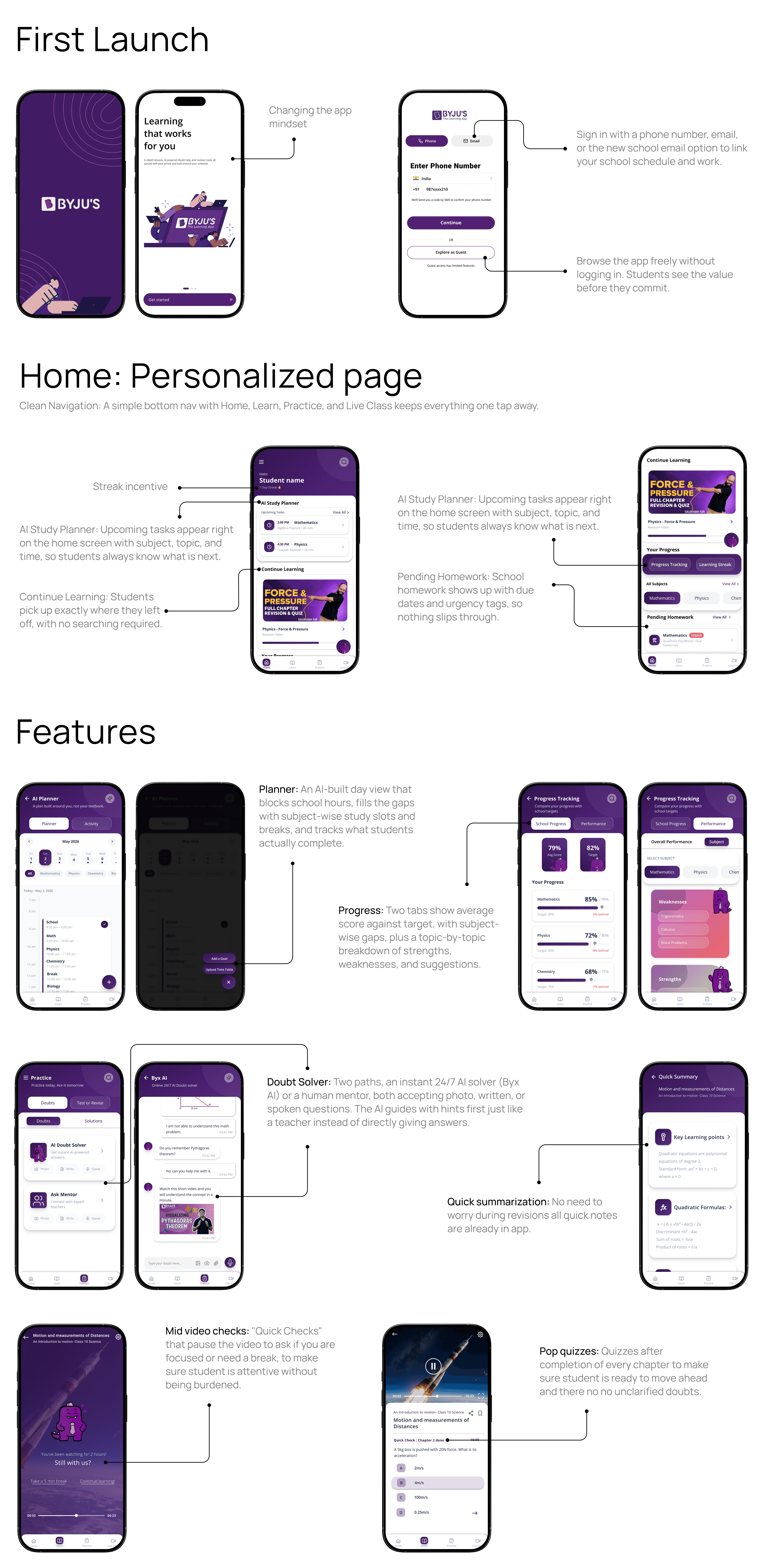
Some more features
A few smaller features carry the same shift: students can cast lessons to a bigger screen, swipe through flashcards, get wrong answers explained and queued for revision, use voice instead of typing, follow a flexible learning path, and stay motivated with a mascot that tracks their daily streak. Below is a rough visualization of these features. (Made with AI)